PTSD IN Order

An online self-management program for PTSD

PTSD IN Order is a self-management program for PTSD. It helps people notice their states earlier, understand how their environment shapes them, and take ownership of their behaviors, including which tools to use and when. They respond before things escalate. The result is fewer crises, better day-to-day functioning, and real self-management.

The approach

Not about eliminating symptoms. About knowing your states.

Users build personalized profiles of their environments, behaviors, comfort zones, and tools — creating a self-management system specific to them. The program works alongside clinical care, not as a replacement for medication or therapy.

The program tracks activation and arousal states — from hypervigilance through flashbacks and dissociation — with graduated tools matched to each level. This reflects that PTSD responses are the nervous system doing its job in the wrong context — and recovery means learning to notice and redirect, not suppress.
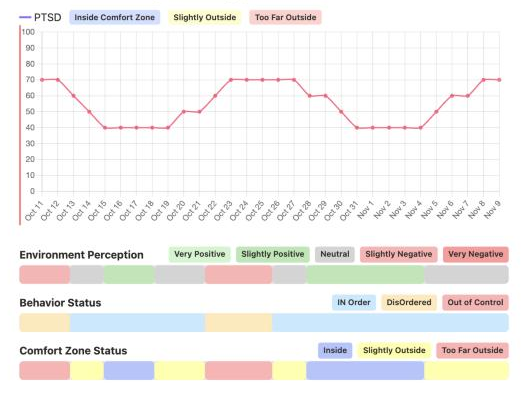
Thirty days of check-ins: intensity against the comfort zone, with environment, behavior and comfort zone status
Thirty days of check-ins
How it works

Three things you learn to do.

1

Understand your states

Learn to observe and identify what you experience in different mental and emotional states, without judgment.

2

Define your comfort zone

Establish personal thresholds for what you can handle while still functioning. Everyone's comfort zone is different.

3

Build your tools

Develop a personalized set of strategies at three levels: simple, stronger, and extreme, so you are always prepared.

Inside the program

Thirty seconds a day. Patterns you can see.

Daily check-in
Daily check-ins

A 30-second check-in

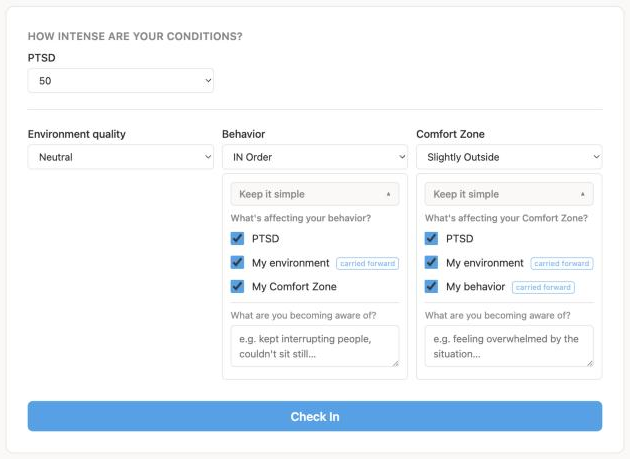
A 30-second daily check-in captures mental state, environment, behavior, and tool usage. Over time, this builds the dataset that drives reports and pattern recognition.

Graduated timeline
Graduated timelines

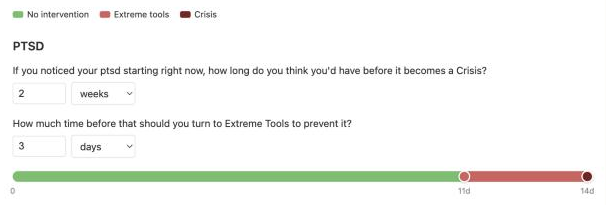
A stepped response, before things escalate

When check-in data shows a trend outside the comfort zone, the program walks the user through a stepped response — starting with awareness, progressing to stronger tools when needed.

Shareable reports
Reports you control

You decide who sees what

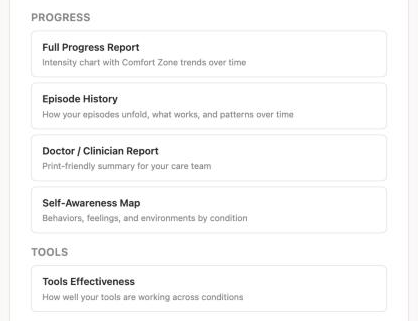
Users can share their check-in data, tool usage, AI coaching conversations, and reports with therapists, doctors, family, or researchers — choosing exactly what each person can and cannot see. A therapist might get the clinical report and tools data. A spouse might see only the weekly summary. The user decides, and can revoke access at any time. All access is logged for HIPAA compliance.

Start here

Know your states. Respond earlier.

Fewer crises, better day-to-day functioning, and real self-management.

Join the Program →